Wednesday, March 27, 2013
Kate Upton is Making a Terrible Mistake
Monday, March 25, 2013
Have We Learned Anything in the Past Five Years?
Posted by An Spailpín at 9:00 AM
Labels: Angela Merkel, EU, IMF, Ireland, Meath East, Mick Wallace, politics, recession, Troika
Thursday, March 14, 2013
Those St Patrick's Day Government Drinking Arrangements in Full
Monday, March 11, 2013
Mayo Are Better Than People Think
Years of disappointment have warped Mayo football people’s ability to see the game steadily and to see the game whole. Mayo fans focus on all the opponents’ strengths, and all of Mayo’s weaknesses. There is never balance.
For instance, when Tyrone beat Mayo a few weeks ago in Castlebar there was general distress that Mayo were behind the times when it came to dealing with the blanket defence of the modern game. No reckoning was made of the fact that Tyrone’s own blanket, while all-enveloping in its pomp, has been somewhat threadbare in recent years.
Dublin are not easy to beat in Dublin. Fourteen men often beat fifteen in Gaelic football. Mayo were unlucky on Saturday night in Newry, but sometimes that happens. It doesn’t mean the sky is going to fall.
James Horan has sustained a certain amount of criticism for not making correct tactical switches to win games. This assumes that Horan’s chief priority is to win these games, which is not necessarily correct.
One thing we did learn after last summer was that Mayo may be one or two players short of an All-Ireland team. Horan’s job in the League is to find those one or two players and find out how they combine with the automatic selections, and he’s only got seven games to do that.
Seven games isn’t enough to run through all his permutations and, if Horan chooses to start someone and it’s not working out, Horan has to give the debutant time. If Horan starts a man and then calls him ashore after twenty minutes or a half, how does he then repair that man’s confidence and show him that Horan trusts him to do a job if he’s called on to do it later in the year?
These are what Horan has to think about. Ideally, the team wins as well. That’s ideal for two reasons. Firstly and most obviously, winning makes everybody feel better. There is no game worth playing that is not worth winning. Secondly, it’d be nice to stay in Division 1 of the National Football League.
However, Horan is surely thinking that winning is secondary to looking at players. Horan’s critics say that he isn’t looking at enough, and certainly he’s not ringing the changes that he rung during his first year in charge. But he doesn’t have to – he’s clearly happy in most positions, or as happy as the manager of the Mayo senior football team can ever be. It’s only those missing few that he’s hunting down, and how to combine them. Sufficient wins should add up to keep Mayo from the drop, and if they don’t, they don’t.
The short nature of the National Football League makes it something of a lottery. Mayo went into their last game last year looking at the drop and ended up in the playoffs instead. This means the League isn’t a true contest. It’s a lottery, a coin toss. It has no worthwhile meaning.
The people of Mayo, before rending their garments and setting their hair on fire in distress, should first conduct a thought experiment. Instead of looking at the team as the Mayo team, look at them at Meath, in the old Kepak golden-grid jerseys. Take away the agony of those lost All-Irelands, and replace it with the Team Who Were Never Bet. What do you see?
Well, you see a fullback in Ger Cafferkey who has grown into his craft to such an extent that extra-curricular impacts are necessary to put a stop to his gallop. You see a midfielder in Aidan O’Shea who may be the best in the country come the summer. Barry Moran beside him isn’t far off, and it was hard not to cheer when Moran made those barging runs into the Down defence on Saturday night.
In fact, those runs by Barry Moran may have excited the imagination to wonder what a Mayo full-forward line of Doherty, B Moran and Conroy – the very blueprint of a Mayo footballer – might do. A lot of the Mayo forward question depends on Andy Moran, of course, and what he can do when or if he returns, but in the meantime, the pieces are there. If the ball can stick inside, Doherty and Conroy can rattle up the scores and then where will we be?
Mayo stormed through the League in the first and last years of Johnno’s Second Coming and a lot of good it did them. This year, eleven weeks until hostilities commence in Salthill, Mayo are doing just fine, thank you.
Posted by An Spailpín at 9:00 AM
Labels: football, GAA, James Horan, Mayo, National Football League, Sport
Tuesday, March 05, 2013
They Are Spartacus - Where to Now for Off the Ball?
Posted by An Spailpín at 9:00 AM
Labels: Ciarán Murphy, Eoin McDevitt, Ger Gilroy, Ireland, Ken Early, Mark Horgan, media, Newstalk, Off the Ball, radio, RTÉ, Simon Hick, Sport
Tuesday, February 26, 2013
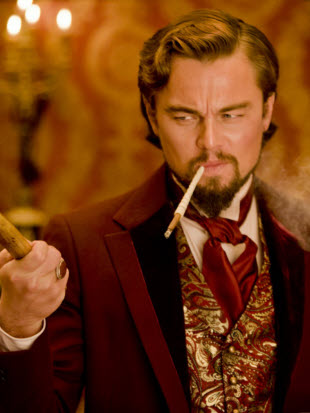
Django Doesn't Deserve Its Oscars
Why Django won its Oscars isn’t all that hard to figure out. Around Christmas, Lincoln was the favourite to sweep all before it as one of those classically Oscar-worthy movies, like Ghandi or A Man for All Seasons. And then two things happened. Firstly, Argo built up momentum and chimed with the inherent US patriotism that saw the Academy Award go to The Hurt Locker ahead of Avatar a few years ago. Secondly, people began to realise that Lincoln, while worthy, is deathly, deathly dull.
Lincoln is three hours of CNN political reporting. It’s one of those movies that will be shown in secondary school history classes from now until Doomsday, while the pupils nod off silently in the dark through generation after generation.
However, the issue of slavery was in the air and Django must have collected a lot of votes as a second-best option for Hollywood to show that actors are aware that slavery is wrong. And Tarantino has been the most exciting director since the young Scorsese in the 1970s so how bad if he gets his moment in the spotlight?
The problem is that Django just isn’t that good. It’s not bad, but it’s heartbreakingly disappointing. And it’s heartbreakingly disappointing because Django could have been the best US slavery movie since Gone with the Wind, and Django’s failure to realise that potential, having been so very close, stings more than if it had not been so very close to glory. We can forgive a popcorn movie for being a popcorn movie because it never pretends to be anything else, but Django is a lost masterpiece, and that should not be celebrated on cinema’s greatest night.
By the start of Django’s fourth act, when Django and Dr Schultz have met Calvin Candie and are making their way to Candieland to free Django’s wife, Broomhilda, the film is outstanding. Truly outstanding. We eagerly await further twists in the tail as master of puppets Tarantino pulls our strings.
But that’s not what we get. That’s not what we get at all. What we get instead is a cheat, a massive cop-out, an utterly phony and completely wrong deux-ex-machina where Tarantino forces one of his characters to break character to facilitate a plot point. All suspension of disbelief is lost at this point. We realise that Tarantino is struggling. That his decline is continuing, and that he will never achieve the maturity that his early career promised.
This is the spoiler. Final warning.
The problem with Django is this. By the end of the fourth act, Django and Dr Schultz have won. Calvin Candie has signed Broomhilda’s letters of freedom, and is taking no steps to avenge himself on our heroes over their attempt to con him. None. It’s a clear win for Django, Broomhilda and Doctor Schultz, and there is nothing to stop them living happily ever after.
Nothing except the half an hour of film that Tarantino has yet to fill. Who knows what his original plans were – a massive slave fight, familiar to fans of cobble-fighting here, perhaps. But he found himself stuck at this point, and escapes his spot by having Dr Schultz behave as we cannot imagine him behaving heretofore.
It’s utterly out of character for Dr Schultz to refuse to shake Calvin Candie’s hand after their deal is done. He’s been in the South for years – he’s shaken hand with worse men than Candie. Equally, he’s seen slaves maltreated before – why would he break now? Because he hears Lara Lee playing Für Elise on the harp and it breaks his heart? I think not. He’s seen and done too much to get sentimental now.
The only reason Dr Schultz breaks, refuses to shake Candie’s hand and eventually shoots him is because Tarantino knows this film has to end on a bang, not a whimper, and this is either the only way he can do it, or because Tarantino was too lazy to figure out another ending.
And the whole film falls away to pieces after that. There’s a good scene between Stephen (and if anyone was getting an Oscar for this, shouldn’t it have been Samuel L Jackson?) and Django in the barn after Calvin’s shooting, but Django’s escape from hapless Aussie larrikin slavers is worse than pathetic. Tarantino should be better than this, and he’s not.
As for Christoph Waltz, he seems a nice man and I hope he’s enjoying his time in Hollywood and making every dollar he can. The astonishing, and not very cheering in terms of the culture, thing about Waltz is that he’s now won two Oscars for playing the same character, The German with the Curl. When he’s good, freeing slaves in the ante-bellum South, he’s very, very good, but when he’s bad – being a Jew-hunting Nazi, say – he’s horrid. And if that’s not ham, then I’m Kevin Bacon.
Posted by An Spailpín at 9:00 AM
Labels: Christoph Waltz, Django Unchained, Leonardo DiCaprio, oscars, Quentin Tarantino, Samuel L Jackson
Monday, February 18, 2013
Joe Brolly and the Problem of Perspective
Posted by An Spailpín at 9:00 AM
Labels: Derry, football, GAA, Joe Brolly, Martin Storey, Mayo, rte, Sport, The Sunday Game